
 Editorials
  Ad Disclosure
 We sometimes use affiliate links in our content, when clicking on those we might receive a commission – at no extra cost to you. By using this website you agree to our terms and conditions and privacy policy.


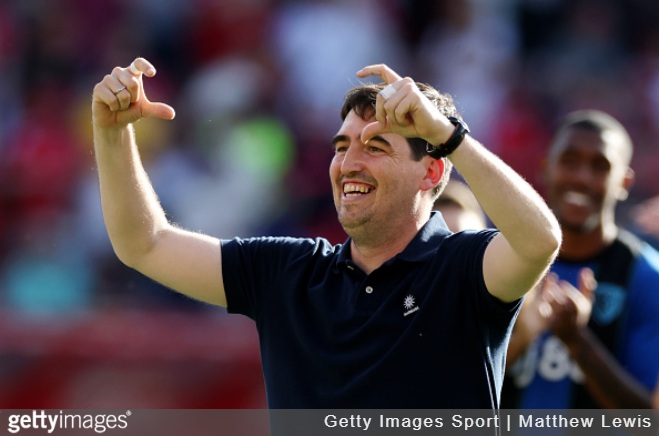
Iraola at Anfield? A Bold Appointment That Could Either Ignite or Overwhelm
Liverpool stand on the brink of another defining moment. Just a year removed from Arne Slot’s title-winning first season—and only days after his dismissal following a disappointing title defense—the club appears ready to pivot dramatically, with Andoni Iraola emerging as the leading candidate to take over at Anfield.
The decision, while abrupt, reflects a broader desire within the club hierarchy to rediscover an identity that has become blurred. And in Iraola, Liverpool may believe they have found the architect capable of restoring something closer to their “heavy metal” roots.
But is Iraola truly the right fit for a club of Liverpool’s stature—or is this a gamble that risks exposing the limits of a rising, but still relatively untested, coach?
From Overachiever to Contender Builder
There is little doubt that Iraola’s work at Bournemouth has been remarkable. Over three seasons, he guided a club previously accustomed to relegation fights to unprecedented heights—including a sixth-place Premier League finish and qualification for European competition for the first time in their history.
Even more impressively, that achievement was underpinned by a clear, identifiable style. Bournemouth were not merely successful—they were distinctive.
Iraola’s teams are defined by relentless intensity. His approach blends aggressive high pressing, fast vertical transitions, and tactical flexibility. Analysts have highlighted how Bournemouth became one of the Premier League’s most effective pressing sides, excelling in disrupting opponents high up the pitch and converting turnovers into attacking opportunities.
On the ball, his sides are anything but rigid. While capable of structured build-up, they are also direct when needed—preferring to progress quickly and exploit space rather than dominate possession for its own sake.
In short, Iraola took a modest squad and gave it a tactical identity that allowed it to punch far above its weight. That alone explains why Liverpool—searching for clarity after a confused stylistic transition—have turned to him.
Why Liverpool Want Iraola
The reasoning behind Liverpool’s apparent move is not difficult to trace.
After Jurgen Klopp, Liverpool began shifting toward a more possession-oriented model under Slot. But the transition never fully settled; instead, the team seemed caught between two philosophies—losing both the pressing ferocity that once defined them and the control Slot sought to introduce.
Iraola represents something closer to a reset than a continuation.
His football is front-footed, energetic, and, crucially, proactive—qualities Liverpool’s hierarchy reportedly view as essential for the club’s next phase.
There is also familiarity behind the scenes. Sporting director Richard Hughes, who worked with Iraola at Bournemouth, is believed to have played a key role in identifying him as the preferred successor—a factor that often proves decisive in modern football appointments.
And in a market where top-level managers are rarely available, Iraola’s availability—combined with his Premier League experience—has made him an especially attractive option.
The Case for Optimism
From a purely footballing perspective, reasons for optimism are abundant.
Firstly, Iraola’s methods have already shown they can translate to the Premier League. His Bournemouth side were not only competitive but capable of beating elite opponents and sustaining long unbeaten runs, suggesting a robustness that goes beyond a “system coach” label.
Secondly, his emphasis on intensity and adaptability aligns with Liverpool’s recent DNA. In many ways, Iraola’s philosophy feels like an evolution—rather than a rejection—of the principles Klopp instilled.
Finally, there is his track record of improving players and maximizing resources. At Bournemouth, individuals flourished within a clearly defined structure, benefiting from a system that prioritized intelligence, energy, and collective responsibility.
At Liverpool, with a deeper and more technically gifted squad, that same system could theoretically scale to even greater heights.
The Fundamental Doubt
And yet, for all the positives, one question looms larger than any tactical diagram:
Can Iraola handle Liverpool?
Managing Bournemouth and managing Liverpool are fundamentally different jobs. The former rewards innovation and overachievement; the latter demands consistency, silverware, and the ability to handle relentless scrutiny.
At Bournemouth, success was defined by exceeding expectations. At Anfield, success is defined by meeting them—week after week, competition after competition.
There is also the matter of adaptation. Iraola’s system, while effective, is demanding. It requires time for players to internalize its pressing triggers, positional rotations, and tactical nuances—a process that even Bournemouth experienced early in his tenure.
At Liverpool, patience is a luxury rarely afforded to new managers.
Furthermore, the step up in game-state expectations cannot be underestimated. Bournemouth often thrived in transitional scenarios, where pressing and counter-attacking flourished. At Liverpool, opponents will sit deeper, forcing Iraola’s system to solve problems it has not consistently faced at scale.
A Calculated Risk
Ultimately, appointing Iraola would represent a calculated gamble.
It is a bet on identity over pedigree—a belief that a coach with a clear footballing vision can succeed at the highest level even without a history of managing elite clubs.
That bet has paid off before in football. But for every success story, there are cautionary tales of promising managers who struggled when the margins tightened and expectations soared.
Verdict: Right Idea, Uncertain Timing
If Iraola does arrive at Anfield, it will signal a bold commitment to a new direction—one rooted in energy, aggression, and tactical clarity.
On balance, he appears to be a logical fit in stylistic terms and an exciting one in philosophical terms. His Bournemouth success is not accidental; it is the product of a defined and effective methodology.
But whether he can replicate that success at Liverpool—where the stakes are exponentially higher—is far from guaranteed.
The appointment, if completed, will not simply be about Iraola’s ideas. It will test his adaptability, resilience, and authority at the very highest level.
In that sense, this is more than just a managerial change.
It is a measure of how much Liverpool are willing to believe in potential—and how quickly they expect it to become reality.
SHARE


IN THIS TOPIC